Jackson MS summer storm roof damage is not always easy to recognize immediately after severe weather. A roof may appear undamaged from the driveway, yet strong winds, hail, heavy rainfall, or falling debris may have affected shingles, flashing, roof vents, and other protective components.
In some cases, homeowners do not notice a problem until weeks or months later.
A small opening around flashing may not produce an obvious leak during every rainstorm. A lifted shingle may settle back into place, concealing a weakened seal. Moisture may also travel through the roof assembly before reaching a visible interior surface.
As Mississippi transitions from summer into fall, additional rainfall and changing weather conditions can make existing roofing problems easier to notice.
However, storm exposure does not automatically mean the roof was damaged. Properly installed roofing systems are designed to withstand ordinary weather conditions, and many homes continue performing well after storms.
The goal is to recognize meaningful warning signs and address confirmed problems before moisture causes additional damage.
In this guide, Pro-Shield Roofing & Construction explains what Jackson homeowners should look for after summer storms, how hidden roof damage can become noticeable during fall, and when to schedule a professional roof inspection in Jackson, MS.
Quick Answer: What Are the Signs of Hidden Summer Storm Roof Damage in Jackson, MS?
Hidden storm-related roofing problems may become noticeable through changes in shingles, flashing, drainage, or interior moisture conditions.
Important warning signs include:
- Missing, lifted, or creased asphalt shingles
- Unusual areas of granule loss
- Possible hail impacts on roofing materials
- Loose or displaced roof flashing
- Damaged plumbing vent boots
- Cracked or displaced roof accessories
- Gutter dents, separation, or drainage problems
- Brown or yellow ceiling stains
- Damp attic insulation
- Water marks around chimneys or skylights
- Recurring leaks during fall rainfall
These symptoms do not always prove that summer storms caused the damage.
Normal aging, installation defects, condensation, and other moisture sources may produce similar conditions.
A professional inspection helps identify visible roofing concerns and determine whether maintenance, localized repairs, or additional investigation is appropriate.
Why Summer Storm Damage Can Stay Hidden Until Fall in Jackson
Jackson and surrounding Central Mississippi communities experience thunderstorms, strong winds, heavy rain, and occasional hail.
The National Weather Service Jackson office explains that damaging winds can occur throughout the year, including during fall.
A summer storm may affect roofing components without creating an immediate interior leak.
Why Doesn’t Every Roofing Problem Show Up Right Away?
Several factors can delay visible symptoms.
Small openings may only leak under certain conditions.
Wind direction and rainfall intensity influence where water travels across a roof.
Water may move through concealed materials.
Moisture can follow framing, roof decking, or insulation before reaching an interior ceiling.
Roofing damage may be difficult to see from the ground.
Lifted shingles, damaged seals, and small flashing gaps may not be obvious from the driveway.
Dry periods can temporarily hide moisture-entry problems.
A vulnerable roofing area may remain unnoticed until later rainfall reaches the same opening.
Why Is Fall a Good Time to Check?
Fall offers an opportunity to review summer storm exposure while roofing materials remain accessible for professional evaluation.
It also allows homeowners to investigate moisture symptoms before another period of heavy rainfall or severe weather.
The key is not simply to look for visible destruction, but to identify changes that suggest the roof’s protective system may have been compromised.
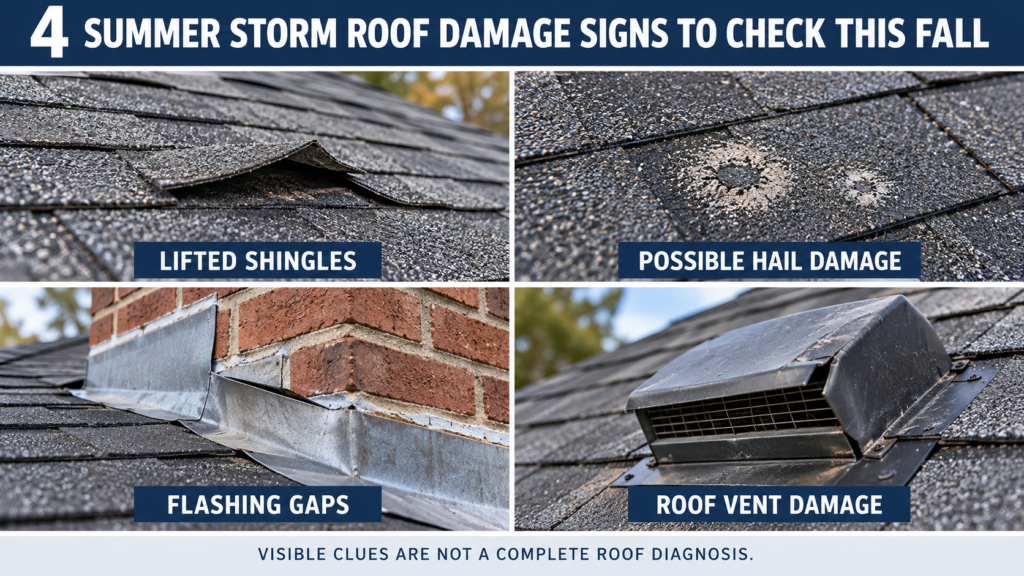
1. Wind-Lifted Shingles Can Look Normal After a Storm
Strong winds create uplift forces on exposed portions of the roof.
Asphalt shingles are installed to resist wind, but previous wear, aging seals, improper fastening, or particularly strong gusts may affect their ability to remain secure.
Sometimes a shingle lifts during a storm and settles back into position afterward.
From the ground, the roof may appear unchanged.
Signs of Possible Wind Damage
- Raised or uneven shingle edges
- Missing shingle tabs
- Creases or tears in roofing materials
- Loose ridge-cap shingles
- Exposed underlayment
- Displaced starter shingles
- Pieces of roofing material found in the yard
Why Does a Lifted Shingle Matter?
Shingles rely on proper fastening, overlap, and sealing to shed rainwater.
When a shingle’s seal or attachment has been compromised, wind-driven rain may have a greater opportunity to reach vulnerable layers beneath it.
However, a raised shingle does not automatically mean water has entered the home.
The condition of surrounding materials and the entire roof assembly should be evaluated before recommending repairs.
2. Hail Damage May Be Subtle or Difficult to Identify
Hail can affect asphalt shingles, roof vents, flashing, and other exterior components.
The severity of damage depends on factors such as hail size, wind conditions, roofing material, and the roof’s existing condition.
What Might Hail Damage Look Like?
Impact-related shingle marks
Some hail impacts may disturb protective granules or affect the underlying shingle material.
Damaged roof accessories
Metal vents, flashing, and other exposed components may show impact marks.
Localized shingle deterioration
Professional evaluation may identify fractured or otherwise compromised shingles.
Damage to adjacent exterior materials
Gutters, siding, and other building components may show signs of storm exposure.
Does Granule Loss Always Mean Hail Damage?
No.
Asphalt shingles can lose granules through aging, weathering, installation activity, and other causes.
Likewise, dents in metal accessories may indicate hail exposure without proving that the shingles themselves were damaged.
A qualified roofing professional should evaluate the overall damage pattern rather than relying on one symptom.
Why Look for Hail Damage During Fall?
If roofing materials were compromised during summer, subsequent rainfall may expose vulnerable areas.
The important step is determining whether the storm affected the roof’s ability to shed water.
Homeowners who suspect hail damage can learn more about Pro-Shield’s professional roof inspection services.
3. Damaged Flashing Can Cause Leaks Long After the Storm
Roof flashing protects vulnerable areas where roofing materials meet chimneys, walls, skylights, and other penetrations.
These connections need to remain properly installed and watertight through changing weather.
Summer storms can expose existing weaknesses or, in some cases, directly damage already vulnerable components.
Common Flashing Problems
- Metal flashing separated from adjoining surfaces
- Loose or missing flashing pieces
- Cracked sealant
- Corroded metal components
- Gaps around chimneys
- Damaged roof-to-wall transitions
- Deteriorated skylight flashing
Why Can Flashing Leaks Be Hard to Find?
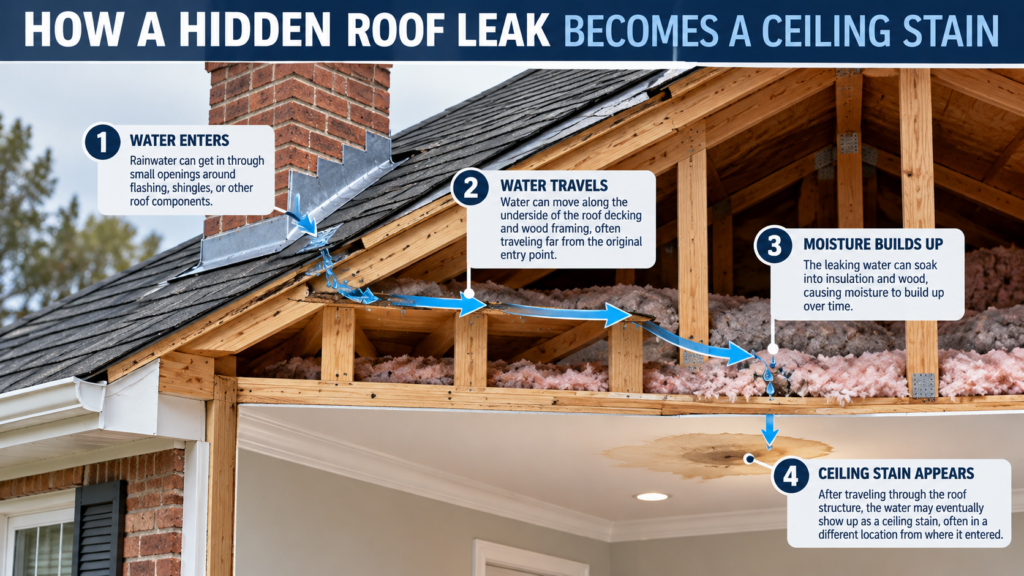
Water entering near a chimney may follow the roof deck or framing before reaching the interior.
The ceiling stain could appear several feet away from the actual entry point.
This is why replacing drywall or applying additional sealant without identifying the source may fail to correct the problem.
A professional inspection should examine the suspected entry point and the surrounding roofing components.
4. Plumbing Vent Boots and Roof Penetrations Deserve Attention
Plumbing pipes, exhaust vents, and other roof penetrations require appropriate weatherproofing.
On many residential roofs, plumbing vents are protected by flashing assemblies with rubber or other compatible sealing components.
Over time, these materials may deteriorate because of age, ultraviolet exposure, and ordinary weathering.
Storms may expose or worsen existing weaknesses.
What Should Homeowners Watch For?
- Cracked rubber pipe boots
- Flashing separated from a vent pipe
- Damaged roof vent covers
- Visible gaps near penetrations
- Rust or displaced components
- Moisture stains near roof openings
A damaged pipe boot may create a localized roofing problem even when the surrounding shingles remain in good condition.
Not every penetration issue requires roof replacement.
A roofing inspection can determine whether an individual component can be repaired or replaced.
5. Ceiling Stains May Reveal a Leak That Started Months Earlier
Sometimes the first evidence of storm-related roofing damage appears inside the home rather than on the exterior.
Water can enter through damaged roofing materials and travel along concealed surfaces.
How a Hidden Leak Develops
Stage 1: An opening exists.
A damaged shingle, loose flashing detail, or deteriorated roof penetration allows water to enter.
Stage 2: Moisture travels.
Water moves along roof decking, framing, or other materials.
Stage 3: Building materials become damp.
Insulation or interior finishes may absorb moisture.
Stage 4: Symptoms become visible.
A ceiling stain, peeling paint, musty odor, or damp drywall may appear.
Signs to Check Inside Your Jackson Home
- New brown or yellow ceiling stains
- Water marks near chimneys
- Bubbling paint on upper walls
- Damp attic insulation
- Stains on attic framing
- Unusual moisture near skylights
- Recurring water marks after rainfall
Is Every Ceiling Stain a Roof Leak?
No.
Plumbing leaks, condensation, HVAC-related moisture, and other building problems can produce similar symptoms.
The source must be identified before homeowners can choose an effective repair.
The U.S. Environmental Protection Agency’s moisture and mold guidance emphasizes correcting water problems and drying affected materials promptly.
6. Roof Valleys and Gutters Can Hide Debris After Summer Storms
Summer storms may leave branches, twigs, and other debris on the roof.
During fall, additional leaves can collect in gutters and valleys.
Roof valleys are particularly important because water from adjoining roof slopes passes through them.
Drainage Warning Signs
- Leaves and branches trapped in roof valleys
- Gutters pulling away from fascia boards
- Downspouts draining slowly
- Water spilling over gutter edges
- Standing water after rainfall
- Dark moisture stains along fascia
- Storm debris covering flashing
Can Clogged Gutters Cause Roof Leaks?
Gutter blockages can contribute to overflow and moisture exposure around fascia, soffits, walls, and foundations.
However, roof leaks may originate from unrelated defects such as flashing or damaged shingles.
Cleaning gutters does not correct a compromised roof penetration or missing roofing materials.
These conditions should be evaluated separately.
Homeowners should avoid climbing onto wet or steep roofing surfaces to remove debris.
7. Mississippi Heat and Humidity Can Complicate Roof Moisture Concerns
Jackson’s hot, humid climate makes it important to distinguish exterior water entry from other moisture problems.
Attic condensation and roof leaks are not the same thing.
For example, an improperly vented bathroom exhaust fan may introduce excess moisture into attic spaces.
Likewise, air-conditioning duct problems or air leakage can contribute to condensation under suitable conditions.
Possible Moisture Sources
Roof leaks
Rainwater may enter through damaged shingles, flashing, or penetrations.
HVAC-related condensation
Moisture may form on inadequately insulated or improperly sealed cold duct surfaces.
Bathroom or kitchen exhaust
Poorly routed exhaust ducts may deposit humid air into attic spaces.
Plumbing leaks
Interior pipes can also cause ceiling stains.
Why Does Accurate Diagnosis Matter?
If an attic moisture problem originates from HVAC condensation, replacing roof shingles may not resolve it.
If rainwater enters through damaged flashing, adding attic insulation alone will not correct the opening.
A qualified contractor should identify the likely moisture source before recommending extensive repairs.
8. What Should Jackson Homeowners Do When They Suspect Storm Damage?
If you notice possible roofing damage during fall, document the condition and avoid unsafe roof access.
Step 1: Review Previous Storm Activity
Consider whether your property experienced strong wind, hail, falling branches, or significant rainfall during summer.
A storm report can provide context, but it does not prove that a particular home sustained roof damage.
The National Weather Service Jackson severe weather resources explain how storm warnings and local storm reports are issued.
Step 2: Observe the Roof From the Ground
Look for missing shingles, displaced accessories, or obvious roofline changes.
Do not climb onto the roof to search for damage.
Step 3: Check the Interior
Look for recurring moisture stains, wet insulation, or signs of water entry after rainfall.
Step 4: Photograph Warning Signs
Take photographs from safe locations and record when the symptoms were first noticed.
Step 5: Schedule a Professional Inspection
A roofing professional can examine visible roofing components and identify areas that may require repair.
Pro-Shield offers professional roof inspections in Jackson, MS for homeowners experiencing leaks, storm-related concerns, or other roofing issues.
Step 6: Review the Findings
Ask which conditions appear to be storm-related, which may be ordinary wear, and what corrective work is actually necessary.
9. Repair or Replacement: What Happens After Damage Is Found?
Not every storm-exposed roof needs replacement.
The appropriate next step depends on the damage, roofing material, age, and condition of the overall system.
When Localized Repairs May Be Appropriate
Repairs may be considered when:
- Only a few shingles are damaged.
- A plumbing vent boot requires replacement.
- Flashing has a specific repairable defect.
- A limited area has been affected by wind.
- Surrounding roofing materials remain serviceable.
When Replacement May Be Worth Evaluating
A larger project may be appropriate when:
- Several roof slopes have widespread damage.
- Roofing materials have extensive deterioration.
- Leaks repeatedly return after appropriate repairs.
- Underlying roof materials require substantial work.
- Localized repairs are no longer a practical long-term solution.
Is Storm Damage Automatically Covered by Insurance?
No.
Insurance coverage depends on the policy, type of damage, deductibles, exclusions, documentation, and the insurer’s decision.
Homeowners should review their policy and contact their insurer to confirm requirements and reporting deadlines.
Pro-Shield’s Central Mississippi roofing services include storm-damage evaluations and assistance with documenting visible roofing concerns.
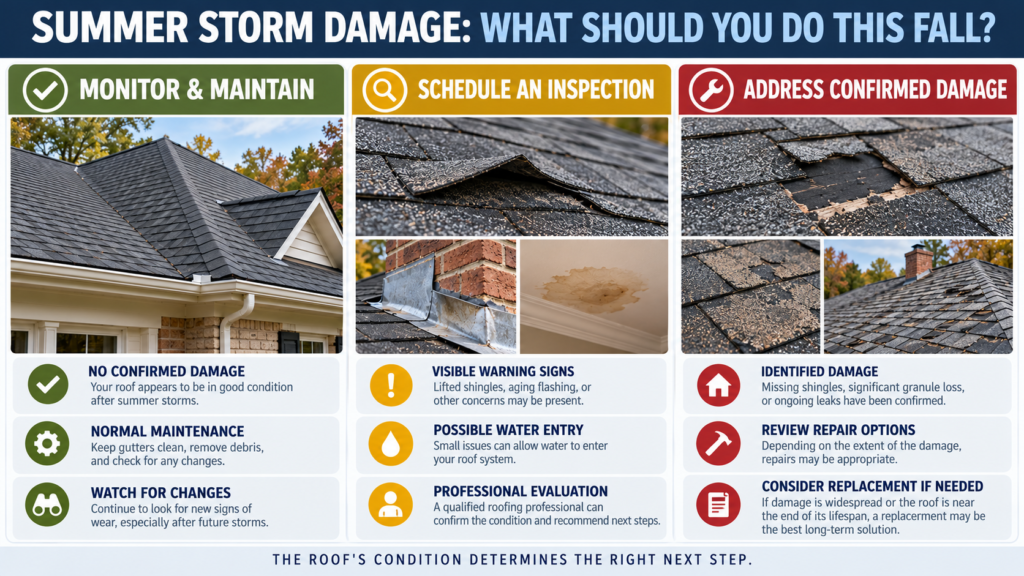
10. A Fall Storm Damage Checklist for Jackson Homeowners
Use this practical checklist to review possible roofing concerns after the summer storm season.
Exterior Roofing Conditions
- Look for missing or uneven shingles.
- Observe exposed roof flashing.
- Check visible roof vents and accessories.
- Look for debris in roof valleys.
- Watch for damage around roof edges.
- Note visible signs of wind or tree impact.
Gutters and Drainage
- Check for loose gutter attachments.
- Look for heavy leaf accumulation.
- Observe water flow during rainfall.
- Check downspouts for blockage.
- Note recurring overflow near roof edges.
Interior and Attic
- Look for ceiling discoloration.
- Check for recurring moisture after rainfall.
- Observe accessible attic insulation for dampness.
- Note stains on roof decking or framing.
- Check around chimneys and roof penetrations.
Documentation and Next Steps
- Save photographs of suspected damage.
- Review past roofing maintenance records.
- Document when symptoms first appeared.
- Schedule an inspection if warning signs exist.
- Ask for written findings and appropriate repair recommendations.
Safety reminder: Do not walk on a wet, steep, or damaged roof. Keep clear of downed power lines, unstable trees, and areas with suspected structural damage.
11. Why a Professional Jackson Roof Inspection Is Worth Considering
A professional roof inspection provides a more complete view than a ground-level check alone.
It can identify visible defects in roofing materials, flashing, roof penetrations, and drainage areas.
What May Be Included in an Inspection?
Depending on the property and service scope:
- Asphalt shingles and roofing materials
- Flashing and roof-to-wall connections
- Roof penetrations and pipe boots
- Visible wind or hail-related damage
- Roof valleys and drainage conditions
- Leak-prone areas
- Observable structural concerns
- General roof deterioration
The purpose is to identify problems and explain the available options.
Pro-Shield Roofing & Construction’s Jackson roof inspection service provides assessments for homeowners concerned about leaks, storm damage, and overall roof condition.
For broader roofing needs, homeowners can also explore Pro-Shield’s roofing services.
A professional inspection does not guarantee that every concealed defect can be discovered without additional testing, but it is a practical starting point.
Summer Storm Roofing Concerns Across Jackson and Central Mississippi
Roofing conditions vary across Jackson neighborhoods and surrounding communities.
Home construction, roof age, tree coverage, previous repairs, and storm exposure all influence the type of roofing problems a homeowner may encounter.
These considerations are relevant to properties in:
- Jackson, MS
- Madison, MS
- Ridgeland, MS
- Flowood, MS
- Brandon, MS
- Pearl, MS
- Clinton, MS
- Canton, MS
- Byram, MS
- Nearby Hinds, Rankin, and Madison County communities
For example, a property with mature trees may experience more falling branches and gutter debris during strong winds.
A home with multiple roof slopes, valleys, and chimneys may have additional flashing and drainage details that require professional attention.
However, neighboring houses may experience very different damage during the same storm.
The most useful approach is to evaluate the actual condition of each property instead of assuming that every home needs the same roofing work.
Frequently Asked Questions About Summer Storm Roof Damage in Jackson, MS
Can summer storm damage remain hidden until fall?
Yes. Some storm-related roofing problems may not produce immediate visible symptoms. Lifted shingles, flashing gaps, or damaged roof penetrations may become noticeable later, particularly when rainfall reaches vulnerable areas.
What are the first signs of hidden roof damage in Jackson, MS?
Common warning signs include missing or raised shingles, damaged flashing, roof accessory problems, recurring ceiling stains, wet attic insulation, and leaks that appear after rainfall.
Can hail damage a roof without causing an immediate leak?
Yes. Depending on the roofing material and impact severity, hail may damage shingles or roof accessories without producing an immediate leak. However, hail exposure alone does not establish that functional damage occurred.
Can strong winds damage shingles without blowing them off?
Yes. Strong winds may lift shingles or affect their seals and fastening without removing them completely. Some problems can be difficult to identify from ground level.
Does a ceiling stain always mean the roof is leaking?
No. Ceiling stains may also result from plumbing, HVAC condensation, or other moisture sources. An evaluation can help determine the cause.
Should Jackson homeowners get a roof inspection after summer storms?
A professional roof inspection is worth considering when strong winds, hail, falling debris, or heavy rainfall were followed by missing shingles, visible deterioration, or recurring moisture problems.
Can storm-damaged roofing materials be repaired instead of replaced?
Often, yes. Localized damage may be repairable when surrounding roofing materials remain in good condition. Widespread deterioration, repeated leaks, or extensive storm damage may justify considering replacement.
Should I file an insurance claim for roof damage discovered in fall?
Review your policy, document the suspected damage, and ask your insurer about reporting requirements. Coverage and deadlines depend on the specific policy and circumstances.
Does Pro-Shield Roofing & Construction serve Jackson, Mississippi?
Yes. Pro-Shield provides roofing inspections and related roofing services in Jackson and surrounding Central Mississippi communities. Visit its Jackson roof inspection page for details.
Conclusion: Don’t Overlook Summer Roof Damage When Fall Arrives
Jackson MS summer storm roof damage may not always be obvious immediately after severe weather.
Wind-lifted shingles, hail-related concerns, damaged flashing, deteriorated roof penetrations, and drainage problems can remain unnoticed until additional rainfall reveals a weakness.
However, not every roofing concern is storm-related, and not every home exposed to severe weather needs major repairs.
A professional evaluation can help distinguish ordinary wear from problems that affect the roof’s ability to protect the property.
For Jackson homeowners, fall is a practical time to review previous storm exposure, investigate recurring moisture, and make informed decisions about necessary roofing work.
Concerned that summer storms may have affected your Jackson roof?
Explore Pro-Shield Roofing & Construction’s Jackson roof inspection services, review its Central Mississippi roofing services, or contact Pro-Shield to discuss your roofing concerns.