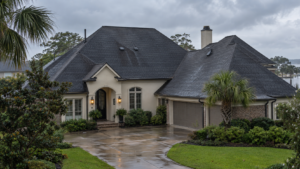
Fall roof maintenance in Ocean Springs, MS is an important part of caring for a home after months of Gulf Coast heat, humidity, heavy rainfall, thunderstorms, and coastal weather exposure.
Ocean Springs homeowners experience environmental conditions that can affect roofing materials differently from homes located farther inland. Moisture-rich air, salt exposure near coastal waters, strong winds, and frequent summer rainfall can place additional demands on shingles, flashing, roof fasteners, and drainage systems.
By the time fall arrives, a roof may look normal from the driveway while still having minor deterioration, loose roofing components, or moisture-related concerns that deserve attention.
The good news is that not every roof exposed to coastal weather needs repair or replacement. A well-installed and properly maintained roofing system is designed to withstand ordinary local weather conditions.
The purpose of fall maintenance is to identify existing weaknesses, recognize potential storm damage, and address confirmed roofing problems before additional seasonal weather arrives.
In this guide, Pro-Shield Roofing & Construction explains what Ocean Springs homeowners should check, how coastal conditions may influence roofing materials, and when to consider a professional roof inspection.
Quick Answer: What Should Ocean Springs Homeowners Check on Their Roof This Fall?
After a long Mississippi Gulf Coast summer, homeowners should check for wind-damaged shingles, corrosion on exposed metal components, deteriorated flashing, blocked gutters, and signs of water intrusion.
A practical fall roof checklist includes:
- Missing, lifted, cracked, or curled asphalt shingles
- Unusual shingle granule loss
- Rust or corrosion on exposed metal roofing accessories
- Loose flashing around chimneys and roof intersections
- Damaged plumbing vent boots
- Debris collecting in roof valleys
- Gutters blocked by leaves, pine needles, or storm debris
- Loose or displaced gutters and downspouts
- Moisture stains around ceilings and attic framing
- Visible damage from summer thunderstorms
- Overhanging branches touching the roof
- Previous roof repairs that may need reevaluation
Many of these warning signs can be observed safely from the ground or from accessible interior areas.
Inspections requiring roof access should be performed by qualified roofing professionals, particularly when surfaces are steep, wet, or potentially damaged.
Why Fall Roof Maintenance Matters in Ocean Springs, Mississippi
Ocean Springs is located along the Mississippi Gulf Coast, where residential roofing systems experience warm temperatures, high humidity, coastal winds, and seasonal thunderstorms.
The National Weather Service in New Orleans/Baton Rouge provides regional weather information and warnings relevant to the Mississippi Gulf Coast.
How Can Coastal Weather Affect a Roof?
Salt air exposure
Salt carried through coastal air can contribute to corrosion on susceptible metal components, particularly when protective coatings are damaged or materials are not suitable for the environment.
Strong winds
Wind pressure can affect shingles, ridge caps, flashing, gutters, and other exposed roofing components.
Heavy rainfall
Frequent rain may reveal weaknesses around roof penetrations, flashing, and drainage areas.
High humidity
Persistent moisture can contribute to biological staining and other moisture-related conditions in susceptible building materials.
Summer sunlight
Ultraviolet radiation and heat contribute to the normal weathering of many roofing materials over time.
These conditions do not mean every Ocean Springs roof will develop damage.
However, homes with aging materials, previous storm damage, or unresolved leaks may benefit from closer inspection during fall.
1. Check Asphalt Shingles for Wind Damage and Weathering
Architectural asphalt shingles are common on residential properties throughout the Mississippi Gulf Coast.
These materials are designed to withstand normal weather exposure, but their condition can change as they age.
Strong winds may lift or displace shingles, while prolonged sunlight and ordinary weathering can contribute to deterioration over time.
What Shingle Warning Signs Should Homeowners Look For?
Missing shingles
Missing roofing materials can leave underlying protective layers exposed to weather.
Lifted shingles
Raised or unsealed shingle edges may be more vulnerable to additional wind-driven rainfall.
Cracked shingles
Visible cracking may indicate aging, material deterioration, or previous damage.
Curling shingle edges
Curled shingles may no longer lie securely against the roof surface.
Excessive granule loss
Widespread loss of protective granules may indicate advanced wear or damage.
Does Every Windstorm Cause Roof Damage?
No.
Roofing systems are designed to resist expected wind conditions when properly installed and maintained.
However, damage may occur when wind forces exceed the resistance of roofing components or when materials are already weakened.
Homeowners who notice missing shingles or visible roof irregularities should consider a professional inspection.
Pro-Shield’s roof repair services can help determine whether localized repairs are appropriate.
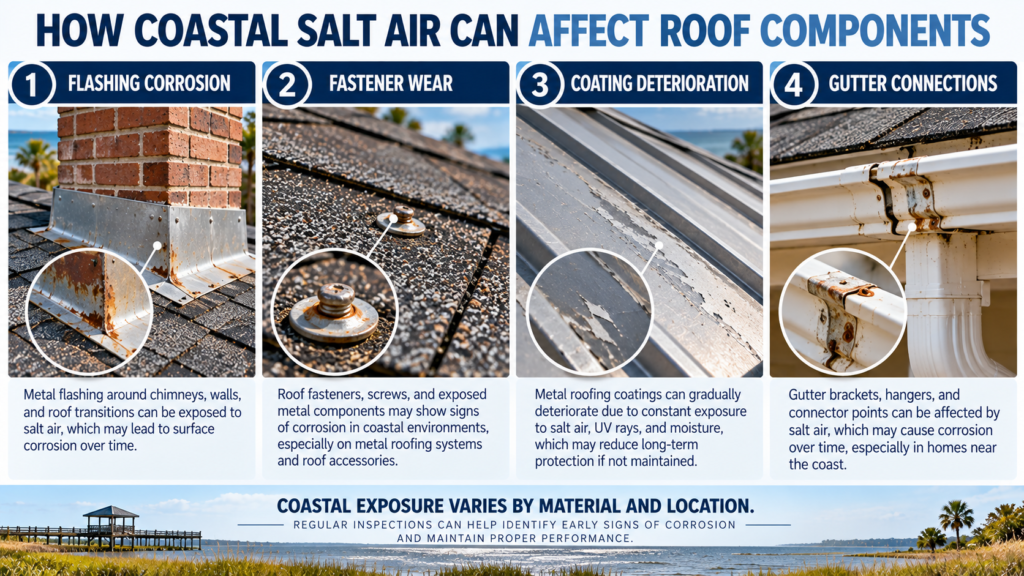
2. Inspect Exposed Metal Components for Salt-Air Corrosion
Salt air is an important consideration for homes located near coastal waters.
Airborne salt particles can settle on exposed surfaces and contribute to corrosion when susceptible metals remain exposed to moisture.
The degree of exposure varies depending on distance from the shoreline, prevailing winds, surrounding structures, and material selection.
Which Roofing Components May Be Affected?
- Exposed metal flashing
- Roof fasteners
- Metal roof accessories
- Gutters and downspouts
- Ventilation components
- Metal roof panels and trim
- Protective coatings on exposed metal
What Are the Warning Signs?
Visible rust
Orange-brown discoloration may indicate corrosion on susceptible steel components.
Deteriorating coatings
Peeling, flaking, or damaged protective finishes may expose underlying metal.
Corroded fasteners
Exposed fasteners with significant corrosion may require evaluation.
Loose metal connections
Deterioration around attachments can affect the performance of some roofing components.
Does Salt Air Damage Every Metal Roof?
No.
Metal roofing systems use different metals, coatings, fasteners, and installation methods.
Products designed for coastal exposure may provide greater corrosion resistance when correctly specified and installed.
A roofing professional can evaluate the material, coating condition, fasteners, and compatibility of exposed components.
For homeowners considering a different roofing system, explore Pro-Shield’s metal roofing services.
3. Look for Roof Damage Left Behind by Summer Storms
Summer thunderstorms can bring heavy rain, strong winds, hail, and falling branches to Mississippi Gulf Coast communities.
Even when a storm does not cause obvious structural damage, roofing components may experience localized wear or displacement.
Common Storm Damage Warning Signs
- Missing shingles
- Lifted or torn shingle edges
- Loose ridge caps
- Damaged roof vents
- Displaced flashing
- Branches or debris on the roof
- Loose gutters
- Water stains appearing after heavy rainfall
Can Storm Damage Remain Hidden?
Yes.
A roof can experience damage without immediately developing a visible interior leak.
For example, a shingle may become partially lifted while remaining attached to the roof.
Similarly, damaged flashing may allow moisture intrusion only during certain wind-driven rain conditions.
This does not mean every roof exposed to severe weather has functional damage.
A professional evaluation can help distinguish ordinary wear, cosmetic changes, and roofing problems that require repair.
The National Weather Service’s thunderstorm safety guidance explains the hazards associated with severe thunderstorms, including damaging winds and hail.
4. Check Roof Flashing Around Chimneys, Walls, and Penetrations
Flashing is an important part of a roofing system because it directs water away from vulnerable connections.
Roof flashing is commonly installed around chimneys, skylights, exterior walls, plumbing vents, and other penetrations.
What Flashing Problems Should You Look For?
Loose chimney flashing
Metal flashing that has separated from adjacent materials may allow water to enter vulnerable areas.
Damaged roof-to-wall flashing
Roof sections that meet vertical walls require properly installed protective details.
Deteriorated pipe boots
Rubber or other sealing components around plumbing vents may crack or deteriorate over time.
Skylight flashing concerns
Water stains near skylights may indicate flashing problems, condensation, or other building-envelope issues.
Damaged roof valleys
Debris accumulation or displaced materials can affect drainage where two roof slopes meet.
Why Is Flashing Especially Important During Coastal Rainstorms?
Wind-driven rain can reach roofing connections from different directions.
When flashing is already damaged or improperly installed, water may find an entry point.
Homeowners should avoid relying on surface sealant as a permanent substitute for correctly installed flashing.
A professional roof inspection can help identify whether a localized repair is needed.
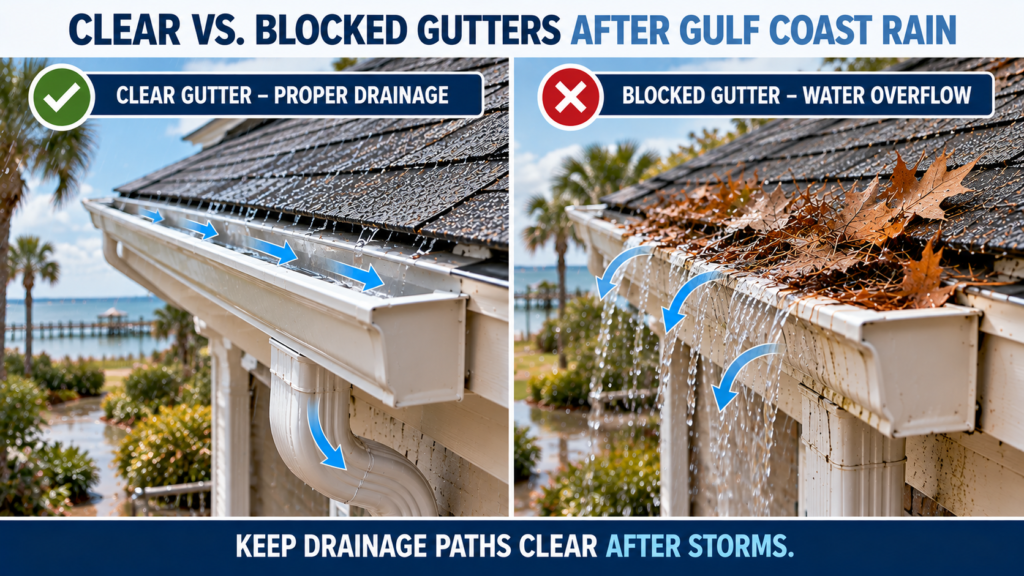
5. Clear Gutters and Downspouts After Summer Storms
Ocean Springs properties with mature live oaks, pines, and other trees may accumulate leaves, needles, and branches around their roofs.
Storm debris can become trapped in gutters and downspouts.
When drainage is blocked, water may overflow rather than move away from the home.
Gutter Warning Signs
- Leaves and pine needles filling gutter channels
- Water spilling over gutter edges
- Slow-draining downspouts
- Sagging gutter sections
- Loose brackets or attachments
- Water staining on fascia boards
- Pooling water near the foundation
Why Does Gutter Maintenance Matter on the Gulf Coast?
Heavy rainfall can expose drainage problems quickly.
Overflowing gutters may contribute to moisture around fascia, soffits, siding, and foundation areas.
However, gutter blockages do not automatically mean the roof itself is leaking.
The source of moisture should be identified before recommending roofing repairs.
6. Inspect Roof Valleys for Debris and Moisture Problems
Roof valleys form where two sloping roof surfaces meet.
These areas carry runoff from adjoining roof sections and require effective drainage.
After summer storms, leaves, twigs, and small branches may become trapped in valleys.
Why Are Roof Valleys Important?
Debris accumulation can:
- Restrict normal drainage
- Retain moisture against roofing materials
- Conceal existing shingle damage
- Cover flashing connections
- Make inspection more difficult
A small amount of debris does not automatically cause a leak.
However, heavy accumulations should be removed safely, particularly when they prevent water from draining normally.
Homeowners should not climb onto steep or wet roof surfaces to clear valleys.
7. Check Attic Areas for Signs of Hidden Roof Leaks
Not every roof leak becomes visible immediately.
Water entering through a roof opening may travel along framing or other building materials before creating a ceiling stain.
This can make the original entry point difficult to identify.
Attic Warning Signs
- Damp insulation
- Water stains on roof decking
- Darkened or discolored framing
- Moisture around plumbing vents
- Water marks near chimney connections
- Recurring musty odors
- Ceiling stains after heavy rainfall
Does Attic Moisture Always Mean a Roof Leak?
No.
Attic moisture may also be related to condensation, plumbing problems, or inadequate moisture control.
High humidity can make these concerns more noticeable in some buildings.
A professional inspection should help identify the source rather than assuming every moisture stain requires roof replacement.
What Should Homeowners Do?
Document the location and timing of stains.
If moisture appears after heavy rainfall, note the weather conditions and whether wind-driven rain was present.
Avoid disturbing electrical equipment or entering unsafe attic areas.
If an active leak is present, arrange prompt professional assistance.
8. Check Trees and Overhanging Branches Around the Roof
Ocean Springs neighborhoods are known for mature trees, including large live oaks.
Trees provide shade and contribute to the character of residential properties, but branches close to a roof can create maintenance concerns.
What Should Homeowners Watch For?
- Branches rubbing against shingles
- Broken limbs hanging above the roof
- Heavy leaf accumulation
- Debris collecting in valleys
- Branches near gutters
- Storm-damaged trees leaning toward the house
Can Tree Debris Damage Roofing Materials?
Large falling branches can damage shingles, flashing, gutters, or underlying roof structures.
Smaller debris may accumulate in drainage areas and retain moisture.
However, trees near a home do not automatically mean the roof is damaged.
The appropriate response depends on the tree’s condition, branch clearance, and roof design.
Have hazardous tree work performed by qualified professionals.
9. Should Ocean Springs Homeowners Consider Metal Roofing?
Metal roofing can be an option for Gulf Coast homes, but coastal suitability depends on material selection, protective coatings, fasteners, installation details, and local exposure.
Potential Advantages of Appropriate Metal Roofing Systems
- Long service life when properly specified and maintained
- Options designed for high-wind conditions
- Durable roofing materials
- Various profiles and finishes
- Potentially lower routine maintenance needs for some systems
What Should Homeowners Consider?
Coastal corrosion resistance
Not all metal products perform equally in salt-rich environments.
Fastener compatibility
Incompatible metals or unsuitable fasteners may contribute to corrosion.
Protective coatings
The condition and suitability of coatings matter.
Wind resistance
Roof system design and installation must account for applicable wind requirements.
Maintenance
Metal roofs still require periodic inspection and maintenance.
Homeowners considering an upgrade can review Pro-Shield’s metal roofing services.
The right material depends on the property, budget, roof design, and applicable building requirements.
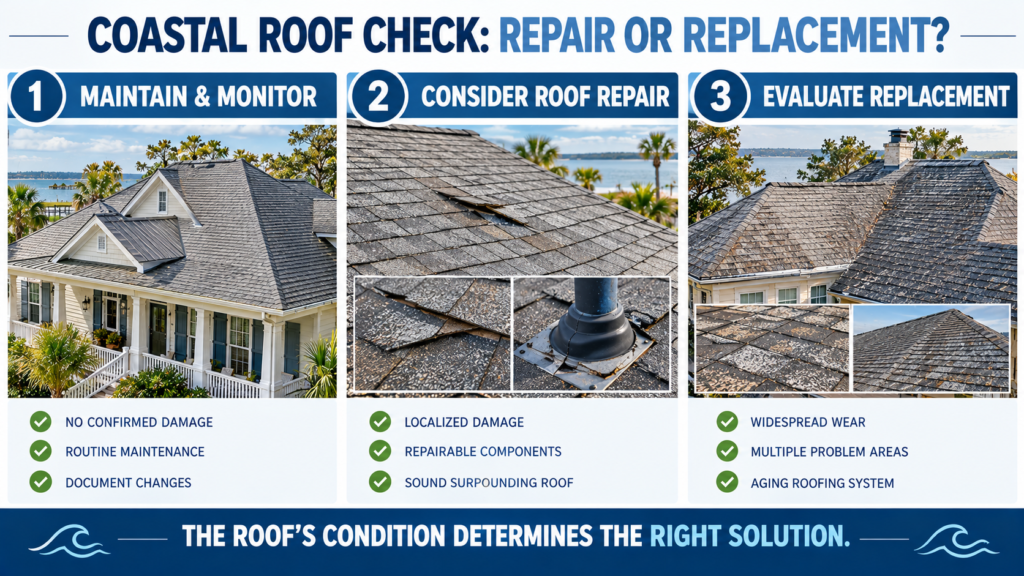
10. Roof Repair or Replacement After a Coastal Mississippi Summer?
Not every roofing problem requires a complete roof replacement.
The appropriate solution depends on the age of the roof, material condition, damage extent, and whether localized repairs can restore proper performance.
When Roof Repair May Be Appropriate
- A small number of shingles are damaged
- One roof vent boot needs replacement
- Flashing damage is localized
- Minor storm damage affects a limited area
- The remaining roofing system is in good condition
When Roof Replacement May Be Worth Evaluating
- Shingle deterioration is widespread
- Multiple roof slopes show significant damage
- Repeated leaks continue after previous repairs
- Roofing materials are approaching the end of their service life
- Large portions of the roof have sustained functional damage
Does Coastal Exposure Automatically Shorten Roof Life?
Not by a fixed amount.
Roof performance depends on material selection, installation quality, maintenance, environmental exposure, and other conditions.
A professional evaluation can help determine whether repair or replacement is the more appropriate choice.
Pro-Shield offers roof replacement services for homeowners considering a new roofing system.
11. A Fall Roof Maintenance Checklist for Ocean Springs Homeowners
Use this checklist to organize a practical roof review after the summer season.
Roofing Materials
- Check for missing shingles from the ground.
- Look for lifted or uneven shingle edges.
- Note cracked or visibly deteriorated roofing materials.
- Watch for significant granule loss.
- Document previous storm damage.
Coastal Metal Components
- Look for visible rust on susceptible metal accessories.
- Check exposed flashing for deterioration.
- Observe metal roof trim and connections.
- Note damaged protective coatings.
- Arrange professional evaluation of corroded fasteners.
Gutters and Drainage
- Remove substantial leaf and pine needle buildup.
- Check downspout drainage.
- Look for sagging gutter sections.
- Inspect roof valleys for debris.
- Watch for fascia staining.
Attic and Interior Areas
- Check ceilings for new stains.
- Look for damp attic insulation.
- Note recurring moisture after rainfall.
- Document musty odors or visible discoloration.
- Investigate moisture around roof penetrations.
Professional Follow-Up
- Photograph visible concerns.
- Review previous roofing repairs.
- Schedule an inspection if damage is suspected.
- Request documented findings.
- Discuss repairs before assuming replacement is necessary.
Safety Reminder: Avoid walking on wet, steep, or potentially damaged roofing surfaces. Professional roof access is recommended when inspection or maintenance cannot be performed safely from the ground.
Fall Roof Maintenance in Ocean Springs and Nearby Gulf Coast Communities
Roofing conditions vary throughout Ocean Springs and surrounding Mississippi Gulf Coast communities.
Homes closer to coastal waters may experience greater airborne salt exposure, while properties surrounded by mature trees may accumulate more debris after storms.
Roof design, roofing material, maintenance history, and previous storm exposure also influence how a roof performs.
Similar seasonal roofing considerations may apply to homeowners in:
- Ocean Springs, MS
- Biloxi, MS
- D’Iberville, MS
- Gulfport, MS
- Gautier, MS
- Pascagoula, MS
- Long Beach, MS
- Moss Point, MS
- Vancleave, MS
However, homes in the same community do not necessarily experience identical roof conditions.
A professional inspection can help identify property-specific concerns.
To learn more about roofing services in the region, explore Pro-Shield’s service areas or roof inspection services.
Frequently Asked Questions About Fall Roof Maintenance in Ocean Springs, MS
How often should Ocean Springs homeowners inspect their roofs?
Homeowners should regularly observe their roofs for visible damage and consider professional inspections when storms, leaks, or other warning signs occur. Fall is a useful time to review roof conditions after the summer season.
Can salt air damage asphalt shingles?
Salt exposure is generally a greater corrosion concern for susceptible metal components than for asphalt shingles. However, coastal homes may also experience wind, moisture, sunlight, and other weathering conditions that affect roofing performance.
Does salt air cause metal roofs to rust?
Salt-rich air can contribute to corrosion on susceptible metals, especially when coatings are damaged or materials are unsuitable for coastal conditions. Corrosion resistance varies by metal, coating, fasteners, and exposure.
What are the signs of wind damage on a roof?
Possible signs include missing shingles, lifted edges, torn shingle tabs, loose ridge caps, damaged vents, and displaced flashing. Professional evaluation can help determine whether functional damage occurred.
Should gutters be cleaned after Gulf Coast summer storms?
Yes, when leaves, pine needles, or storm debris restrict drainage. Clear gutters help direct rainfall away from the home and reduce overflow around fascia, siding, and foundations.
Can a roof leak without visible shingle damage?
Yes. Water may enter around flashing, roof penetrations, skylights, or other vulnerable connections even when most shingles appear intact.
Is metal roofing a good option for homes near the Mississippi Gulf Coast?
It can be, when the roof system is properly specified for local wind and coastal exposure. Material selection, coatings, compatible fasteners, and installation quality are important considerations.
Should I repair or replace my roof after a summer storm?
The appropriate solution depends on the extent of damage, roof age, material condition, and whether localized repairs can restore performance. Storm exposure alone does not automatically justify replacement.
What is the best time for fall roof maintenance in Ocean Springs?
Fall is a practical time to review roofing materials and drainage after summer storms. However, confirmed leaks or significant storm damage should be addressed promptly rather than delayed until a particular season.
Does Pro-Shield Roofing & Construction serve Ocean Springs, Mississippi?
Homeowners can contact Pro-Shield Roofing & Construction to confirm current service availability and discuss roofing inspections, repairs, or replacement needs in Ocean Springs.
Conclusion: Protect Your Ocean Springs Roof After a Long Gulf Coast Summer
Fall roof maintenance in Ocean Springs, MS helps homeowners identify roofing concerns after months of heat, humidity, salt-air exposure, heavy rainfall, and summer thunderstorms.
Wind may loosen shingles, coastal moisture can contribute to corrosion on susceptible metal components, and storm debris can restrict drainage around gutters and roof valleys.
These conditions do not automatically mean a roof requires replacement.
The most practical approach is to inspect visible roofing components, document meaningful warning signs, and address confirmed problems before additional weather exposure creates complications.
For Ocean Springs homeowners, fall maintenance is an opportunity to protect the roof’s existing performance and make informed decisions about repairs or replacement.
Concerned about your roof after another Mississippi Gulf Coast summer?
Explore Pro-Shield Roofing & Construction’s roofing services, schedule a professional roof inspection, or contact the team to discuss your roofing concerns.
Call Pro-Shield Roofing & Construction at (601) 265-1786 to get started.